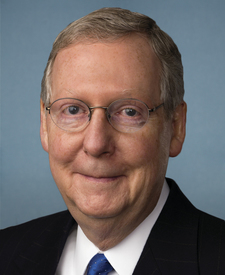
McConnell's Hospitalization and the 36% Question: What the Actuarial Math Says
Mitch McConnell went quiet, and Washington noticed. According to AP, McConnell spoke to Republican leaders as speculation swirled about his health while he remained hospitalized. No timeline. No public accounting. Just a senator, hospitalized, and a caucus trying to function around the silence. Reuters described the absence as a mystery, with the Senate poised to return and no clear indication of when, or whether, McConnell would be back on the floor. That is the word Reuters chose: mystery. Not a routine absence. Not a scheduled recovery. A mystery, reported by a wire service with no partisan stake in the outcome. NPR eventually reported that McConnell himself broke weeks of silence, saying a fall led to the hospitalization. Axios confirmed the same account within the same news cycle. Two more outlets, one explanation, arriving only after weeks had already passed. The Hill reported that Kentucky Governor Andy Beshear, the man who would appoint a successor if the seat vacated, requested a health update of his own. Five outlets. One thread running through all of them: a senator's health became a matter of public record only after weeks of silence, and only after the mechanics of succession started to matter to the people whose job it is to plan for them.
McConnell is 84 years old. He has served in the Senate since 1985, which puts his tenure at 41 years, a career that predates the internet, the modern cell phone, and most of his current colleagues' first campaigns. His current term would end when he is 85. Too Damn Old's actuarial model puts his probability of completing that term at 36%. That number is not a diagnosis. It is not a prediction of any specific medical event, and it says nothing about the fall NPR and Axios reported. It is a probability derived from age and term length, the same kind of math an insurer runs before writing a policy on a client it has never met. A 36% completion probability means the more likely mathematical outcome, taken purely as a matter of actuarial modeling, is that the term is not completed as originally elected. That is true regardless of what caused this particular hospitalization. It was true before the fall, and it remains true after the explanation. If the seat does vacate, for any reason, at any point before the term's natural end, Kentucky taxpayers face a special election cost of $11 million. That figure exists independent of any health event currently in the news. It is the fixed price of a Senate seat interruption, already on the books, already calculated, well before a hospitalization made headlines and put the number in front of anyone outside an actuarial spreadsheet.
McConnell's numbers do not exist in isolation, and that is the point. Congress currently has 192 members aged 65 or older, with an average age of 73 within that group. Twenty-seven members are 80 or older, a cohort McConnell belongs to alongside a handful of colleagues who rarely make headlines the way he did this cycle. The oldest currently serving member is Chuck Grassley, at 92, a figure that puts McConnell's 84 years in a strange kind of context: not an outlier, but a data point on a longer curve. This is not a story about one senator having one difficult stretch. It is a story about an institution where a meaningful bloc of decision-makers is old enough that actuarial tables, not just approval ratings or fundraising totals, are relevant to basic workforce planning. The Senate does not have a mandatory retirement age. It does not have a standard succession protocol beyond gubernatorial appointment, a process that varies by state and depends entirely on the judgment of whoever happens to hold the governor's office at the moment a vacancy occurs. What Congress has, instead, is a growing number of members whose individual completion probability, like McConnell's own 36%, sits well below the assumption quietly baked into a six-year term when the voters cast their ballots.
The silence documented by Reuters and AP, followed eventually by the explanation reported by NPR and Axios, illustrates a structural gap that has nothing to do with any individual member's judgment or character. There is no standing mechanism requiring a senator to disclose a hospitalization in real time, and no requirement that the public learn anything beyond what the member chooses to share, on the member's own schedule, through the member's own preferred channel. Beshear's request for an update, as reported by The Hill, underscores how thin that mechanism really is: even a sitting governor with direct successor-appointment authority, someone whose office would be responsible for managing the consequences of a vacancy, had to formally ask. That is the system functioning as designed, not as a failure of any single office or any single person. It simply reveals what the design actually is. The $11 million special election cost is a number that sits quietly on a ledger until a vacancy makes it real money, spent by a state that had no say in the timing. A 36% completion probability is a number that sits quietly in a dataset until a hospitalization makes it suddenly relevant to millions of people who had never thought to look. Neither number moved because of new information about McConnell's specific condition. They were already there, calculated in advance, indifferent to any particular fall or any particular hospital stay. The hospitalization did not change the math. It just made people look at math that had been sitting there the whole time.
The full actuarial profile for Mitch McConnell, including completion probability and term data, is available at toodamnold.com/member/M000355. For an explanation of how these numbers are calculated, visit toodamnold.com/human-decency.