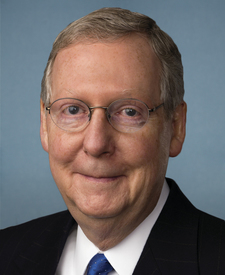
Speak or Resign: The Math Behind Beshear's Demand on McConnell's Health
A sitting governor just told a sitting senator to either come clean about his health or leave office. That's not a normal Tuesday in American politics. According to Axios, Kentucky Governor Andy Beshear has escalated his demand that Senator Mitch McConnell disclose his health status, and The Hill confirms the ultimatum: disclose the details, or resign. Both outlets agree on the core fact. This isn't a rumor bouncing around a group chat. It's a governor, on the record, saying the public deserves to know the condition of the man representing them, or deserves a replacement.
We're not going to speculate about what's actually going on with McConnell's health. That's not our job, and it's not what the record supports. What we can do is show you the numbers around the seat itself, because those numbers explain exactly why this demand landed the way it did, and why it matters far beyond one senator, one governor, or one news cycle.
Think about what it takes for a governor to say this publicly. Beshear isn't a random critic. He's the chief executive of the state McConnell represents, the person who would have to manage the fallout if that seat opened up tomorrow. When someone in that position starts talking about disclosure and resignation in the same breath, it's worth asking what he's looking at that the rest of us should be looking at too.
Mitch McConnell is 84 years old. He has served in the Senate for 41 years, since 1985, which means he has held this seat longer than most Kentuckians have been alive. If he completes his current term, he'll leave office at 85.
Our actuarial model puts the probability that he completes that term at just 36 percent. That's not a coin flip. That's a seat where the odds favor an unplanned vacancy over a clean finish. Flip it around: the model gives a 64 percent chance that this term does not end the way terms are supposed to end, with the senator walking out the door on his own timeline.
And an unplanned vacancy isn't free. Kentucky taxpayers would be on the hook for an estimated 11 million dollars to run a special election if the seat opens before term's end. That's a real number attached to a real risk, not an abstraction sitting in a spreadsheet somewhere.
So when a governor stands up and says disclose or resign, he's not being dramatic. He's responding to a mathematical reality the public can see plainly: a 41-year incumbent, in his mid-80s, with worse-than-even odds of finishing the job he was elected to do. The health disclosure fight isn't happening in a vacuum. It's happening because the actuarial risk here is real, measurable, and already priced into what taxpayers might have to spend if this seat comes open sooner than the calendar says it should.
Zoom out and McConnell stops looking like an outlier and starts looking like a data point in a much bigger pattern. Right now, 192 members of Congress are age 65 or older. Their average age is 73. Twenty-seven members are 80 or older, an entire cohort of octogenarians and near-nonagenarians holding some of the most consequential jobs in the country. The oldest currently serving member, Chuck Grassley, is 92.
McConnell isn't the exception that proves anything. He's one node in a gerontocracy that has quietly become the norm in the institutions writing the laws for a country whose median age is decades younger than the people doing the writing. When 27 members are over 80, disclosure fights like the one playing out in Kentucky aren't going to stay isolated to one senator. They're a preview of a conversation Congress is going to have again and again, seat by seat, as more of these members approach the actuarial cliff that McConnell is already standing on.
Here's the structural problem nobody wants to say out loud: Congress has no mandatory retirement age, no routine health disclosure requirement, and no mechanism that forces an aging member to prove fitness for duty the way, say, commercial airline pilots or many judges do. The only check is political pressure, which is exactly what Beshear is applying now. Public demand becomes the substitute for a rule that doesn't exist.
That gap is what makes a 36 percent completion probability so consequential. It's not just an actuarial curiosity. It's a preview of a governance problem: when a seat this significant carries worse-than-coinflip odds of an early vacancy, the state has to plan, practically and financially, for a scenario the system itself refuses to formally acknowledge. An 11 million dollar special election isn't a hypothetical line item. It's a number sitting on a shelf, waiting to see if it gets used.
The disclosure fight, then, isn't really about one senator's medical chart. It's about whether the public gets to see the risk they're already carrying, or whether they find out only after the seat is vacant and the bill comes due. Every year a seat like this goes without a clear answer is another year the actuarial risk sits there unaddressed, quietly compounding, while the institution built to serve the public pretends the question doesn't apply to it.
You can look at McConnell's full actuarial profile, including tenure, completion odds, and vacancy cost, at toodamnold.com/member/M000355. And if you want to understand exactly how we calculate completion probability and why we think it's the most honest number in American politics, read the methodology at toodamnold.com/human-decency. The data doesn't editorialize. It just sits there, waiting for someone like a governor to point at it and ask the obvious question.