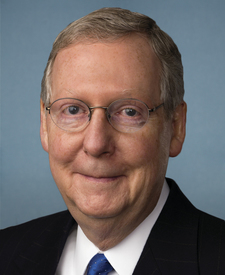
Mitch McConnell Has a 36% Chance of Finishing His Term. Now There's a Health Emergency.
Kentucky's governor is done waiting. Andy Beshear has publicly upped his demand that Mitch McConnell disclose his health status, and The Hill is now reporting the obvious question hanging over the Capitol: will McConnell even return to the Senate. That's not a rumor from an anonymous staffer whispering in a hallway. That's two outlets, on the record, asking whether an 84-year-old senator can finish the job he was elected to do.
This isn't the first time McConnell's health has become a national story, and that's exactly the point. When something like this keeps happening, it stops being a one-off headline and starts being a data problem. Data problems are what we track, day in and day out, for every aging member of this Congress. And McConnell's file is one of the starkest we've got.
Here's what we know about McConnell, cold, no spin attached. He's 84 years old. He has served in the Senate for 41 years, since 1985, longer than most Americans have been alive, longer than entire federal agencies have existed. His current term ends when he's 85. And according to our actuarial model, he has just a 36% probability of completing that term.
That number isn't a guess pulled from a headline or a hunch about how bad things look right now. It's a completion probability, the kind of figure an actuary would hand you if you asked them to bet money on whether someone in McConnell's position finishes the job they were elected to do. A coin flip would give better odds than 36%. Flip a coin twice and you'd beat this number more often than not.
If McConnell's seat vacates before the term ends, Kentucky taxpayers are on the hook for a special election that costs an estimated $11 million. That's not an abstraction sitting in a spreadsheet somewhere. That's a real bill, for a real outcome, that our own data says is more likely than not to happen before this term is over. Somebody has to pay for democracy when a seat opens up early, and in this case that somebody is Kentucky.
Zoom out and McConnell stops looking like an exception and starts looking like a symptom of something much bigger. There are 192 members of Congress age 65 or older right now, sitting in the House and Senate making decisions that will outlast their own tenure. Their average age is 73. Twenty-seven members are 80 or older, an entire cohort of octogenarians steering policy on war, taxes, and healthcare for a country whose median age is decades younger than theirs.
The oldest currently serving member, Chuck Grassley, is 92 years old. Ninety-two. That's not a typo, and it's not an insult aimed at Grassley personally. It's a fact about a system that has almost no mechanism for asking whether someone can still physically and mentally do the job, only mechanisms for asking whether they can still win the next election. McConnell's health emergency isn't a strange, isolated crisis that came out of nowhere. It's what happens when you build a legislature with no retirement age, no mandatory checkups, and no plan, and then just wait to see who breaks first.
A 36% completion probability doesn't mean McConnell will definitely leave office before his term ends. It means that if you ran this exact scenario over and over, in more than six out of ten versions he wouldn't make it to the finish line still holding the seat. That's the actuarial reality sitting underneath the political question Beshear is asking out loud and The Hill is now reporting as a live storyline.
It also means the $11 million special election cost isn't a hypothetical line item buried in a budget footnote. It's a live contingency that Kentucky may actually have to fund, on short notice, because the Senate has no better system for handling this than crossing its fingers. Congress has no age limit and no mandatory disclosure standard for health, which means the public is left piecing together the truth from press conferences, silence, and dueling headlines instead of straight answers. The data doesn't resolve the political fight over transparency. It just tells you the odds while everyone else argues about the optics of who said what and when.
McConnell's situation is one senator's story, but it's also a stress test for a Congress full of members well past the age where most Americans are told to start planning for retirement instead of reelection. Twenty-seven members over 80. A 92-year-old still casting votes. A 41-year Senate veteran with worse odds of finishing his current term than a coin flip has of landing heads.
This is not about one man's health. It is about whether a governing body this old, on average, can keep functioning without the public even knowing basic facts about its members' fitness for the job.
Want the full picture on McConnell, including the numbers behind that 36%? Check his page at toodamnold.com/member/M000355. And if you want to know exactly how we build numbers like that, no black box, read the methodology at toodamnold.com/human-decency. The data's there. What you do with it next is up to you.