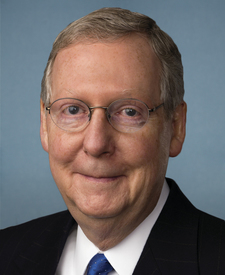
Beshear Tells McConnell to Prove He's Fit or Resign: What the Numbers Already Say
Andy Beshear didn't mince words. According to both AP News and NPR, Kentucky's governor is calling on Mitch McConnell to prove he's fit to serve, or resign. That's not a rival campaign operative or an anonymous staffer floating a talking point. That's the sitting governor of McConnell's own state, on the record, saying it plainly, in daylight, for anyone to hear.
We don't do speculation here. We don't diagnose anybody's health from a podium moment or a viral clip, and we're not going to start now. But we do track something nobody can spin or wish away: the math of time. And on that front, this news didn't come out of nowhere. It landed right on top of a set of numbers that already made the question of whether McConnell can finish his term a live one, not a hypothetical dreamed up by a critic.
That's the whole point of keeping actuarial data on every aging member of Congress. You don't need a controversy to know the odds. The odds were sitting there quietly before Beshear ever opened his mouth.
McConnell is 84 years old. He has served in the Senate for 41 years, since 1985, representing Kentucky the entire time. If he completes his current term, he'll leave office at age 85, a milestone plenty of people never reach at all, let alone while holding a full-time job that requires floor votes, committee work, and cross-country travel.
Our completion probability for McConnell sits at 36 percent. Read that number slowly and let it sink in. That's not a measure of loyalty or effort or dedication to the job. It's an actuarial estimate of whether a senator in his position, at his age, actually finishes what he started. Right now, the data says it's more likely than not that he won't. Not a coin flip tilted his way. Tilted against.
And resignations aren't free, not for the people footing the bill back home. If McConnell's Senate seat vacates, Kentucky taxpayers are on the hook for an estimated 11 million dollars to run a special election. That's real money, pulled from real budgets, spent not because voters demanded a do-over, but because the actuarial clock and the political calendar don't always agree on when it's time to go.
Zoom out and McConnell stops looking like an exception and starts looking like a symptom of something much bigger. Across Congress right now, 192 members are age 65 or older. Twenty-seven of them are 80 or older, an entire cohort making decisions for the rest of us well past the age most Americans have left the workforce behind. The average age of that 65-plus bloc is 73, which means McConnell isn't just above average, he's a full decade past it, sitting near the far edge of an already-old chamber.
He's also not the oldest, not by a long shot. That distinction belongs to Chuck Grassley, currently serving at age 92. So when a sitting governor has to publicly demand fitness proof from an 84-year-old senator, and the chamber down the hall has a member eight years older still casting votes on the nation's business, you're not looking at one lawmaker's personal story. You're looking at the shape of an entire institution that has quietly normalized staying well past the point most workplaces would even discuss retirement.
Here's the uncomfortable part: none of this requires a scandal or a health crisis to be a real problem worth naming. A 36 percent completion probability isn't an accusation, it's a statistical reality about what tends to happen when someone stays in a demanding job into their mid-80s. The Beshear demand is a political and public trust story unfolding in real time. The 36 percent is a separate, colder fact that was sitting in the data before the governor said a single word about it.
What ties the two together is incentive, or rather the lack of one. There is no mechanism in the Senate that forces anyone to step aside because the actuarial odds have shifted against them. Nobody loses their seat because a probability crossed some threshold on a spreadsheet. The only things that change the equation are public pressure, exactly the kind Beshear just applied on national television, or the passage of time itself, which never negotiates. That's the core dysfunction Too Damn Old exists to document: a system with 192 members over 65 and zero built-in checkpoints for whether staying is still the right call, for them or for the people they represent back home.
The 11 million dollar special election price tag is the practical, dollars-and-cents cost of that gap. It's what happens when institutional design assumes lawmakers will make a graceful exit on their own timeline, and reality, stubborn and indifferent, doesn't always cooperate with that assumption.
McConnell's complete actuarial profile, including exactly how his 36 percent completion probability was calculated, is live at toodamnold.com/member/M000355. If you want to understand how we build these numbers, no guesswork, no dramatic rounding, no invented figures, the full methodology is laid out at toodamnold.com/human-decency. The data doesn't have an opinion on whether McConnell should resign. It just has a number, and that number has been telling this story for a while now. Go look at it yourself.