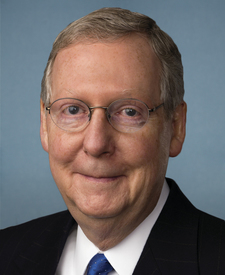
McConnell's Hospitalization and the 36% Question: What the Actuarial Table Says
Mitch McConnell has confirmed what he had not confirmed for weeks: a fall led to his hospitalization. The senator broke his silence in statements reported by AP and NPR, both attributing the account to McConnell himself. Axios adds a separate development, that Kentucky's governor has demanded an update on McConnell's health status, a request that implies the public record so far has not been sufficient to satisfy the state's own chief executive. Three outlets, three angles on the same underlying fact: the 84-year-old senator was hospitalized after a fall, and the governor of his home state wants more information than has so far been made available.
None of the three reports characterize McConnell's underlying condition, and this piece will not speculate on it either. What can be examined, without guessing at anything medical, is the actuarial position McConnell occupies within the institution he has served for four decades, and what that position means in plain numerical terms, using only the figures already on record.
McConnell is 84 years old and would be 85 at the end of his current term. Too Damn Old's model puts his probability of completing that term at 36 percent. That is not a medical diagnosis. It is a completion probability, a single figure built to answer one question: does this member, given age and term length, finish the job the voters assigned him.
McConnell has served since 1985, which puts his tenure at 41 years, one of the longest active runs in the chamber. Kentucky's state government, per this dataset, would face an $11 million bill for a special election if the seat were vacated before term's end. That figure is not a prediction that the seat will vacate. It is the fixed cost attached to the scenario, sitting on the ledger regardless of whether it is ever triggered by any specific event, this week's hospitalization included.
Put the three numbers next to each other: 84 years old, 36 percent completion probability, $11 million contingent liability. None of them, individually, is alarming. Together, they describe a seat where the actuarial risk and the fiscal exposure are both nontrivial and both quantifiable, which is precisely the point of tracking them before a news event forces the question into the open. The governor's demand for a health update is, in effect, a public acknowledgment that this liability is being watched by more than just an actuarial model.
McConnell is not an outlier in isolation, he is a data point in a much larger distribution. Congress currently has 192 members age 65 or older, with an average age within that group of 73. Twenty-seven members are 80 or older. The oldest currently serving member, Chuck Grassley, is 92, eight years past where McConnell sits today.
This is the frame that matters: McConnell's hospitalization is a single, verified event, but it lands inside a Congress where more than two dozen members are already carrying the same 80-plus actuarial profile McConnell does. The institution is not aging at the margins. It is aging at scale, with a substantial bloc of members sharing McConnell's basic risk category, just without the news cycle currently pointed at them. A fall, a hospitalization, a governor's public inquiry: these are the kinds of events that turn an abstract completion probability into a live question, but the probability existed for all 27 members of that 80-plus cohort before any of them made headlines this week.
A hospitalization confirmed by the member himself, followed by a governor publicly demanding more information, is a fact pattern that exists independent of party or policy. It is a data event. The completion probability model does not need to know what caused the fall to register that an 84-year-old serving in a role with an 85-year-old term-end age carries a 36 percent chance of finishing it. That number was already sitting in the dataset before this week's headlines. The hospitalization did not create the risk, it just made the risk visible to people who were not already watching the actuarial table.
The $11 million special election figure works the same way. It is not a comment on McConnell's fitness for office, and it is not a forecast of what will happen next. It is the price tag Kentucky's budget carries as a standing liability for as long as the seat is occupied by someone with a sub-50 completion probability. Whether that liability is ever paid depends on facts no dataset and no outside observer is positioned to predict. What is quantifiable is that the liability exists, on the books, right now, attached to a specific seat and a specific term. That is also why a governor asking for a health update is not a partisan act. It is a question any official responsible for a state budget would be expected to ask when the actuarial exposure sitting under a Senate seat is measured in eight figures.
None of this resolves into a verdict about what should happen. It resolves into a set of numbers that were true last month, are true this week, and will remain true regardless of how this particular hospitalization is ultimately explained.
The full actuarial profile for Mitch McConnell, including completion probability and tenure detail, is maintained at toodamnold.com/member/M000355. For a full explanation of how completion probability is calculated and why Too Damn Old tracks it independent of party, see toodamnold.com/human-decency.