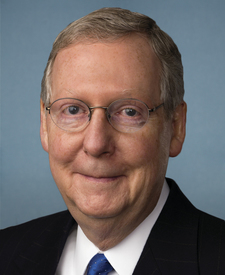
McConnell Breaks Silence on Fall, Hospitalization: What the Actuarial Math Says
Mitch McConnell has confirmed that a fall led to his recent hospitalization, according to AP and NPR, ending several weeks of silence about his condition. Axios reports that Kentucky's governor has since demanded an update on McConnell's health status. No further medical detail has been confirmed across multiple sources, and none is offered here. What is confirmed, plainly, is this: a sitting U.S. Senator was hospitalized, the cause has now been named as a fall, and the state's chief executive is asking questions in public, on the record. The weeks of silence preceding this confirmation are themselves part of the record, noted by two of the three outlets covering this story. That silence is now over. What replaces it is a single, narrow fact: a fall, a hospitalization, and a governor who wants more than that.
This is not a story about diagnosis or prognosis. It is a story about disclosure, timing, and the machinery that surrounds a senator's health once it becomes a matter of public interest rather than private concern. Too Damn Old does not speculate on what comes next medically. It tracks what the numbers say about continuity, and those numbers do not require a diagnosis to be meaningful.
McConnell is 84 years old. He has served in the Senate since 1985, a tenure of 41 years, one of the longest active runs in the chamber. His current term ends when he is 85. Too Damn Old's completion probability model, which estimates the likelihood a member finishes their current term, puts his odds at 36 percent. That figure existed before this week's news broke and is not an adjustment made in reaction to it. It is simply the baseline actuarial reality of an 84-year-old senator with roughly a year remaining on the clock, built from age, tenure, and term length, nothing else.
If the seat vacates before the term's natural end, Kentucky is on the hook for a special election estimated at 11 million dollars. That figure does not shift based on the reason for vacancy, whether retirement, resignation, or something else entirely. It is a fixed cost of the calendar meeting biology, and it is borne entirely by the state, not by the institution that seated him, and not by the party that holds the seat. Eleven million dollars is what turnover costs on paper, regardless of the story behind it.
McConnell is not an outlier in isolation. He is a data point inside a much larger distribution that Too Damn Old tracks across the entire Congress. There are currently 192 members age 65 or older, with an average age of 73 within that group alone. Twenty-seven members are 80 or older, a bracket McConnell sits comfortably inside. The oldest currently serving member is Chuck Grassley, at 92, a reminder that McConnell's 84 years, while advanced, is not the ceiling of what the institution currently tolerates.
What distinguishes McConnell's case this week is not his position relative to peers on an age chart. It is the fact that a health event has surfaced publicly, been confirmed by name across independent outlets, and prompted a sitting governor to request an update in public. That combination, age, tenure, and a confirmed hospitalization with an active gubernatorial inquiry, is not common even within this older cohort. Most of the 192 members 65 and older serve out their terms quietly. The ones who generate headlines like this one are a small subset, and McConnell now belongs to it.
A 36 percent completion probability is not a prediction of what will happen to any one person. It is a statement about the odds embedded in age, tenure, and term length, run through a model that treats every member identically regardless of party, state, or seat. For McConnell, that number was already low relative to most sitting senators before this week's confirmation of a fall and hospitalization. The news does not change the model's inputs, since age and term length were already fixed. What it changes is the public's access to information that the model already accounted for in aggregate.
The Axios report of a gubernatorial request for a health update signals that the question of continuity is no longer confined to actuarial tables and quiet spreadsheets. It has entered the public and political record, where a governor, not just a modeler, is now asking for answers. Whatever happens next, the 11 million dollar special election cost is the number Kentucky taxpayers would face if the seat turns over before the term's natural end. That cost exists independent of any individual's health outcome. It is simply what vacancy costs, on the books, right now, and it will be the same number whether the seat changes hands next month or not at all before the term concludes.
Full actuarial profile and term data for Mitch McConnell is available at toodamnold.com/member/M000355. For a full explanation of how completion probability, average age figures, and special election cost estimates are calculated across all 535 members, see the methodology at toodamnold.com/human-decency.