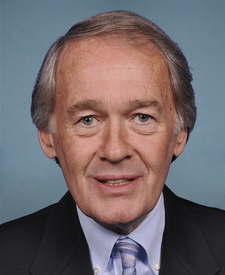
Ed Markey Beat 'Generational Change' Again. He's 80 and Has Served 51 Years.
Ed Markey just won his Massachusetts Democratic primary. That's the news. But it's how he won that matters here: his opponent ran explicitly on generational change, and lost anyway. AP, The Hill, and Politico all framed the race the same way, as a test of whether a party electorate would actually vote out an 80 year old incumbent when given a clear, direct choice to do so. The answer was no. Markey shrugged it off, in The Hill's words. Politico spent its coverage asking how he'd survive the challenge. He didn't just survive it. He won it comfortably enough that it wasn't really a contest by the end.
That's worth sitting with for a second. This wasn't a sleepy race nobody paid attention to. It was a named, covered, national-press generational clash, with a real opponent making the age argument as loudly and directly as it can be made in American politics. And the generational challenger lost anyway. If age-based challenges can't move the needle even when voters are handed the argument on a silver platter, in a state that prides itself on paying attention to its politics, what does that tell you about how entrenched incumbency really is? It tells you the problem isn't that voters don't hear the argument. It's that the argument alone isn't enough to overcome five decades of name recognition, fundraising infrastructure, and institutional muscle memory.
Markey is 80 years old. He has served in Congress since 1975. That's 51 years, spanning nine presidencies' worth of American political life. Let that number sit next to the fact that plenty of voters casting ballots in this primary weren't alive when Markey first took office, and their parents may not have been either.
He just won a new term that will end when he's 81. Our completion probability for that term, based on actuarial data, sits at 55%. That's barely better than a coin flip that he finishes the very term he was just elected to serve. And if he doesn't, if the seat has to be filled through a special election before the term is up, Massachusetts taxpayers are on the hook for an estimated $22 million to run it.
Those aren't attack lines. They're just what the math says about a Senate seat held by the same person for over half a century, now extended for another term with a bare-majority chance of being fully served. A coin flip is an unusual place to leave a $22 million contingency sitting on the table, but that's exactly where this race landed.
Zoom out and Markey stops looking unusual and starts looking typical. There are 194 members of Congress age 65 or older right now. Their average age is 73. That's not a handful of elder statesmen scattered around the Capitol for color. That's a substantial governing bloc, old enough collectively to have lived through most of the history that younger colleagues only read about.
And it goes further up the age ladder than most people assume. 27 members are currently 80 or older, Markey's own bracket. The oldest currently serving member of Congress is Chuck Grassley, at 92, still active in a chamber where Markey is one of dozens, not one of a kind. Markey isn't testing the outer edge of what the institution tolerates. He's comfortably within a well-established range, one that keeps expanding every cycle as incumbents keep winning.
A generational challenge failing doesn't mean the generational problem isn't real. It means the mechanism voters have for addressing it, a primary challenge, isn't strong enough on its own to overcome the built-in advantages of incumbency: name recognition, fundraising networks, institutional relationships built over 51 years in the same job. Moulton made the age argument as directly and publicly as it can be made, and it still wasn't enough to change the outcome.
That has a cost attached to it beyond the abstract talking point. A 55% completion probability isn't a scandal, it's actuarial reality applied honestly to an 80 year old starting a fresh six-year term. But it also means Massachusetts is carrying real, quantifiable risk, a nearly coin-flip chance of triggering a $22 million special election, baked into a race that voters just settled with a clear result. Multiply that kind of risk across 194 members age 65 and older, 27 of them 80 or older like Markey, and you're not looking at one senator's personal story anymore. You're looking at a structural feature of how Congress ages in place, term after term, largely immune to what the electorate says it wants when it's actually asked the question directly at the ballot box.
Markey's full actuarial profile, including how we calculated that 55% completion probability, is on his member page at toodamnold.com/member/M000133. If you want to understand exactly how we build these numbers and why we think they matter, the methodology is laid out plainly at toodamnold.com/human-decency. Don't take our framing for it. Look at the data yourself and decide what a 51 year Senate career, just extended one more time, actually costs the people it represents.