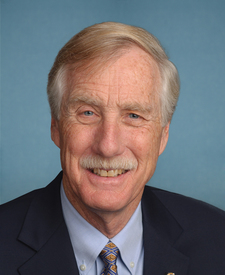
A King Dies at 89. Another King, Age 82, Has a 46% Shot at Finishing His Term
This week the world's newsfeeds filled up with the name King. King Harald V of Norway, described by Reuters and NPR as a reform-minded monarch, died at 89, and his son became King Haakon VIII. AP also reported the death of Oyo Nyimba, Uganda's young monarch, at 34. Two very different men, two very different lives, one shared fact: mortality doesn't check a calendar for convenience, and it doesn't care how the headlines are arranged.
Here in the United States we have our own King. Senator Angus S. King, Jr. of Maine, an independent, is 82 years old. He's not in the news for dying. He's very much serving, showing up, casting votes. But the coincidence of the name is a useful jolt, because it forces a question Too Damn Old exists to ask out loud, again and again until someone in power actually answers it: what happens when the people writing our laws are, actuarially speaking, running out of runway?
We're not being morbid here. We're being honest about a system that asks people in their 80s to commit to six more years of service and then acts shocked when the math doesn't cooperate.
Angus King has served in the Senate since 2013, 13 years and counting. He's currently 82. If he serves out his current term, he'll be 87 when it ends. That is not a hypothetical stretch goal dreamed up to make a point. That's the job as currently structured, the literal calendar he's signed up for.
Our data puts his probability of completing that term at 46%. Say that number back to yourself: 46%. Not a typo, not a worst-case scenario buried in fine print, just the plain math of actuarial odds applied to an 82-year-old serving until age 87. It is close to a coin flip whether Maine's senior senator is still in office, still serving, on the day his current term is scheduled to end.
And if that seat does come open before its time, Maine taxpayers are looking at a $7 million special election to fill it. That is not a partisan cost, and it is not an abstraction. That is what it costs, in real dollars, to replace someone in a system that has no mechanism for planning ahead, no glide path, no succession plan built into the job description. Just a seat, a term, and a coin flip.
Here's the thing about Angus King's numbers: they're not a scandal, they're a pattern. Congress right now has 194 members age 65 or older, and the average age within that group is 73. Twenty-seven sitting members are 80 or older. The single oldest member currently serving is Senator Chuck Grassley, at 92, still on the job, still voting, still older than almost every person most Americans will ever meet in daily life.
So when you look at Angus King's 46% completion odds, you are not looking at a fluke. You are looking at one data point inside a Congress full of them, an institution where being in your 80s while holding a seat that can decide war powers, federal budgets, and Supreme Court confirmations is unremarkable. Normal, even, routine enough that nobody blinks. Twenty-seven members are sitting in that 80-plus bracket right alongside him, and 194 members in total are old enough that actuarial tables start to matter more than campaign platforms.
A 46% completion probability doesn't mean anything is imminent, and it doesn't mean anyone should expect the worst. It means the odds are close to even that a sitting U.S. senator finishes out the term voters elected him to serve. That is the actuarial reality of asking an 82-year-old to commit to serving until 87, in a job with no mandatory retirement age, no cognitive testing requirement, and no upper age limit written anywhere in the Constitution.
Multiply that kind of math across 194 members age 65 and up, 27 of them 80 or older, and you get an institution that is structurally unprepared for its own demographics. Special elections cost millions of dollars that could go almost anywhere else. Committee seniority resets and reshuffles. Staff scrambles to keep constituent services running. Voters lose representation mid-term through no fault of their own, no scandal, no vote they cast wrong, just time doing what time does. None of this requires anything specific to happen to Angus King. It just requires you to look at the numbers and understand what 46% actually represents: a coin flip on continuity, baked into the system by age alone, sitting quietly under a job title that sounds permanent but never actually was.
Angus King's full profile, including how we calculate completion probability, is posted at toodamnold.com/member/K000383. If you want to understand the actuarial methodology behind every number in this post, that is laid out plainly at toodamnold.com/human-decency. No spin, just the math. Go check the work, then go ask your own senators how old they'll be when their term ends.